Why Wagner Moisture Meters and Probes Belong in Every Sawmill and Lumber Operation
If you've ever dealt with lumber that warped, checked, or split after leaving your mill — or wood that arrived at a job site in worse shape than expected — chances are moisture content was the culprit. Controlling moisture isn't optional in the forestry and lumber business. It's the difference between a profitable operation and costly rework, degrade, and unhappy customers.
That's why here at CSP Forestry, we've long carried Wagner Meters' lineup of moisture measurement tools. They're not just reliable — they've become an industry standard for good reason.
What Makes Wagner Different?
Most people are familiar with the old-style pin moisture meters — the ones with two sharp probes you push into the wood. They work, but they're slow, they damage your lumber, and they only read moisture at the surface. That surface reading can be misleading, especially with freshly dried or rain-wetted boards.
Wagner's approach is fundamentally different. All Wagner moisture meters use a pinless, non-destructive scanning method that reads moisture content from inside the wood, not just on its surface. As we note on our product pages, all Wagner moisture meters have the unique ability to truly read the moisture in the wood, not on the wood, and the measurements are not adversely affected by the presence of absorbed moisture on the lumber surface. That's a critical advantage in real-world mill conditions.
Independent research backs this up. A study published in the Forest Products Journal tested 441 wood samples across 30 batches and 14 species, comparing the Wagner L612 against three resistance-type pin meters — and the Wagner L612 was the most accurate of all four.
The Wagner L622: Built for the Lumber Mill
For sawmill and lumber production environments, the Wagner L622 Digital Recording Lumber Moisture Meter is a workhorse. It takes up to 5,000 separate moisture readings and stores them in up to 200 organized groups for comparison of average moisture content, standard deviation, and minimum and maximum values. That kind of data logging is invaluable for tracking drying performance and meeting grading standards.
Key specs worth knowing:
- Scanning depth of 1 inch, measurement range of 5% to 30%, and 32 user-selectable species settings that can be customized by the operator
- Built-in real-time clock and calendar, nonvolatile memory that retains readings even when batteries are changed, and an RS-232 serial interface for connecting to a computer
- Easy-to-read backlit LCD with a two-line, 32-character display and up to 8 hours of continuous battery life
The L622 also comes with Stak Pak software so you can send reports directly to a printer or export data for advanced analysis — useful for quality control documentation and customer reporting.
Don't Overlook the L722 Stack Probe
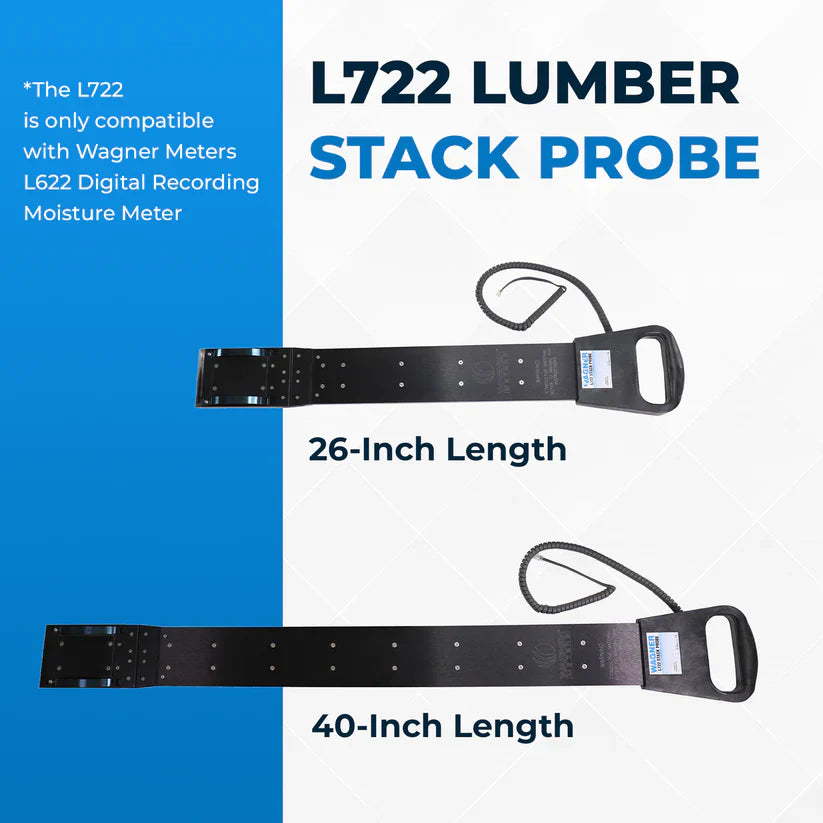
One of the most underused tools in lumber quality control is a good stack probe. The L722 Stack Probe lets you reach deep into stickered units of lumber to find hidden moisture pockets that a surface scan would never catch. It pairs directly with the L622 (and the L5300) and is especially important when checking kiln packages before they ship.
Hidden moisture deep in a stickered stack is one of the sneakiest causes of degrade — the outside of a unit can read fine while the interior boards are still holding too much moisture. The L722 takes the guesswork out of it.
The L5300: For High-Volume Operations
For sawmills and secondary wood products operations, the L5300 Industrial Handheld Moisture Meter is Wagner's most feature-rich model, offering built-in histogram readings, a Quick Import function, expanded storage capacity, and compatibility with WoodStat Pro moisture data analysis software. It measures moisture one inch deep and pairs with the L722 Stack Probe to locate hidden moisture and generate detailed moisture analysis reports.
If you're running a high-volume operation and need serious data to back up your drying decisions, the L5300 is the tool to look at.
The Bottom Line
Moisture problems in lumber don't just affect your product — they affect your reputation. Minimizing costly over-drying and under-drying, recovering more high-grade lumber, and avoiding drying-related degrade like checking, cupping, and splitting all come down to accurate moisture monitoring throughout the drying process. Wagner's tools make that possible.
For over 60 years, Wagner Meters has been a trusted partner to sawmills and wood manufacturers worldwide, delivering patented moisture measurement solutions that reduce waste, improve grade recovery, and boost the bottom line. That's the kind of track record we're proud to stand behind at CSP Forestry.
Ready to take control of your moisture readings? Browse our full selection of Wagner Moisture Meters and Probes at cspforestry.com or give us a call at 800-592-6940.